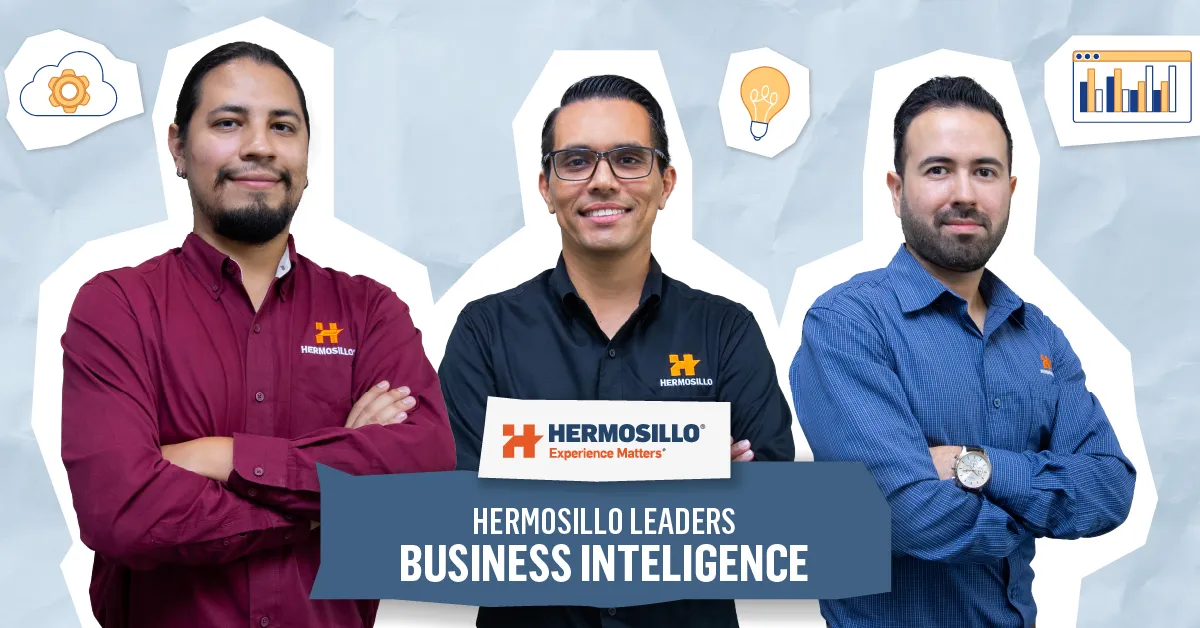
At Hermosillo, data is a key tool for making better decisions. The Business Intelligence team transforms information into actionable insights that drive efficiency, strategy, and collaboration across the company.
Learn how their work directly impacts our projects and processes.
1. What is the main role of the Business Intelligence team at Hermosillo?
Abraham: Our role is to help build a culture that encourages critical analysis of information for decision-making within the organization. We also provide the analytical tools our collaborators need to make that possible. We are a service-oriented team with the vision of being a catalyst that empowers the company’s strategies.
Jorge: In Business Intelligence, we make sure data actually serves a purpose. We ensure that information is captured correctly, processed without errors, and available when needed by different areas. We build and maintain information processes from data extraction and cleaning to transforming it into valuable inputs for analysis or decision-making. Our work helps the company gain clarity, avoid assumptions, and plan more precisely.
Antonio: Our goal is to create the right conditions for all areas of the company to make better decisions. We focus on ensuring they have access to high-quality, timely, and intuitive information. We aim to build a culture where data becomes a natural part of everyone’s daily work so that decisions are backed by evidence and aligned with the group’s objectives.
2. How do your analyses and reports help improve decision-making in design and construction projects?
Abraham: We provide our collaborators with information that offers clarity and concrete answers to their questions. In doing so, we contribute to better decision-making, both strategic and operational.
Some examples of tools and processes we’ve developed include:
- Current status and progress analysis for project closures
- Current and historical contract load reports
- Cash flow monitoring by project
- Cost and variance analysis
All of these projects have been developed in collaboration with the teams involved, and we maintain ongoing communication to ensure they remain valuable and relevant.
Jorge: Our tools are designed so that decision-makers have clear, structured information. When data is well-presented, working with it becomes easier, and decisions are made more confidently.
Antonio: The information we provide gives project leaders the certainty that they’re using the best data available. This reinforces their judgment, reduces uncertainty, and builds confidence when taking action.
Our reports integrate commercial, operational, and financial data clearly and on time, making it easier to spot trends, anticipate risks, and optimize execution time.
3. How do you collaborate with other departments to turn data into strategic actions?
Abraham: It’s definitely a team effort. We begin by talking with stakeholders to understand the questions they need to answer, the decisions they need to make, the information they currently use (or could use), and how these decisions impact the business. That’s our starting point to define a conceptual diagram or project charter that helps validate objectives and ensures the tool we develop has a real impact on their decisions and operations.
Once the tool is delivered, we stay in touch to fine-tune indicators and define continuous improvement criteria.
Jorge: We approach each area to understand their specific needs and how they use information in their day-to-day work. Based on that, we design processes, reports, and automations that are truly useful and functional.
Antonio: We work closely with each area to deeply understand their operations, key decisions, and the questions they need to answer. It’s not just about delivering data; we support teams in interpreting it, crafting clear narratives, and communicating insights effectively within the organization.
4. What tools, processes, or methodologies have been key to the evolution of the team’s role in recent years?
Abraham: In terms of methodology, adopting a top-down approach has been fundamental; it keeps us aligned with the strategic objectives of leadership. Regarding tools and processes, we’ve improved how we manage BI projects to better align with Hermosillo’s specific needs. Also, migrating our data platform to Amazon Web Services (AWS) has been crucial in helping us reach our current level and preparing us for the future.
Jorge: AWS gave us the foundation to centralize and structure our data. From there, our focus has been on adopting only the tools and processes that genuinely add value: automating, standardizing, and ensuring data flows without unnecessary complexity.
Antonio: The evolution of our area has been possible thanks to a solid Business Intelligence infrastructure, which includes:
- Efficient data processing and centralized storage that ensures a single source of truth
- Scalable data modeling aligned with business processes
- Best practices in data visualization to create intuitive and user-friendly dashboards
- Methods for data storytelling and internal communication to drive adoption
In addition, our migration and tech modernization through AWS has enabled faster, safer solutions aligned with the company’s growth.
5. How do you foster a data-driven culture at Hermosillo?
Abraham: A data-driven culture can’t be the responsibility of just one team, but naturally, we’re a key part of the company’s strategy. We work closely with the Communications team to integrate these topics into internal campaigns and embed them into what it means to Be Hermosillo.
We also collaborate with directors, managers, and team leads who actively encourage their teams to use our tools. Ultimately, the most effective way to promote this culture is to maintain regular contact with each area, provide ongoing support, and reinforce the value of evidence-based decision-making.
Jorge: When data is clean, organized, and accessible, people start using it naturally. Once they realize it helps solve real problems, the culture begins to build itself.
Antonio: We foster it by creating the right conditions: ensuring that data is accessible, understandable, reliable, and delivered at the right time. We also promote strong consultation habits so that each decision-maker can combine their experience and intuition with high-quality data. This strengthens a company-wide culture of better, evidence-based decision-making.