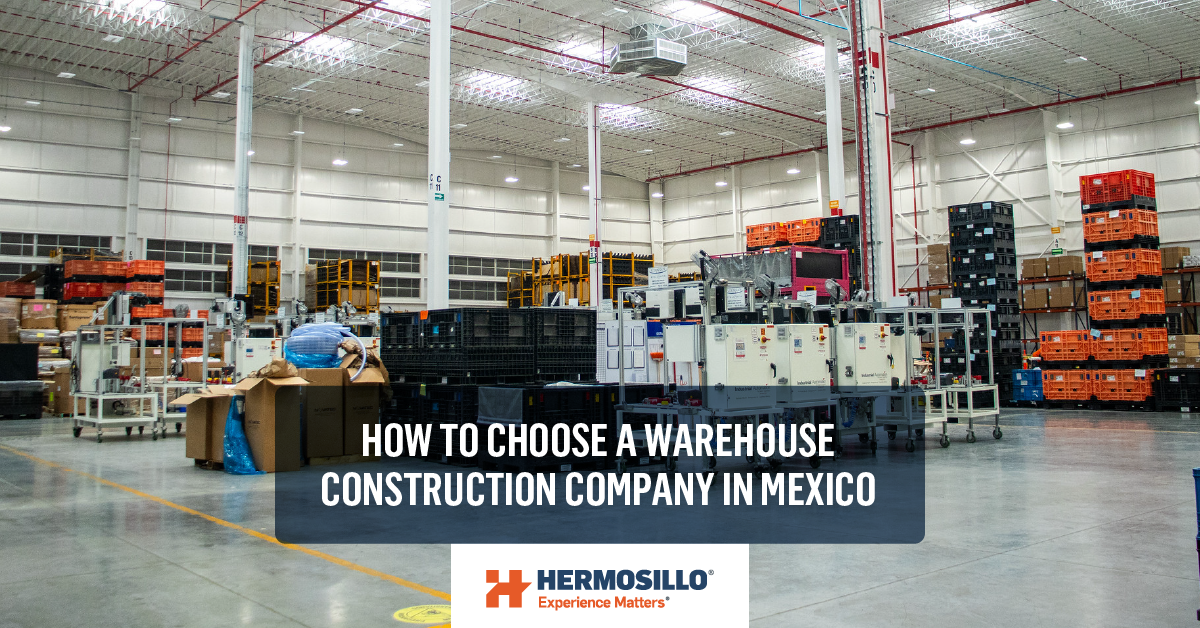
Building a warehouse or distribution center in Mexico requires more than finding someone to build it. It requires a partner who can anticipate challenges, understand local conditions, maximize the property’s full capacity, and make strategic decisions from the earliest stages. Factors such as site conditions, permitting, utilities, procurement, logistics efficiency, and design-construction coordination can directly impact cost, schedule, and long-term operations.
For companies expanding into Mexico, choosing the right warehouse construction company is therefore one of the most important decisions in the project.
An experienced construction partner should understand not only how to build the facility, but also how to navigate the specific challenges of warehouse construction and industrial construction in Mexico.
So, what should you look for when evaluating warehouse construction companies in Mexico?

1. Look for Proven Warehouse and Distribution Experience
Industrial construction is a broad category. A contractor experienced in manufacturing facilities may not necessarily have the same expertise required for a large multi-distribution center or logistics facility.
When evaluating a distribution center construction contractor, look for experience with facilities that have similar operational requirements and levels of complexity.
Warehouse projects have their own design and construction considerations, including:
- Clear heights and structural spans
- Loading docks and dock equipment
- Truck courts and trailer parking
- Heavy-duty interior floors
- Fire protection systems
- Electrical and mechanical infrastructure
- Material handling and automation requirements
- Employee and vehicle circulation
- Future expansion capabilities
When evaluating potential construction partners, review their experience with facilities that are comparable in size, complexity, use, and operational requirements to your project.
A strong portfolio is important, but the details behind those projects matter even more. Ask what challenges the contractor encountered, what scope they handled, and how they helped the client meet schedule, budget, and operational objectives.
2. Evaluate Their Knowledge of Building in Mexico
For international companies, experience in the Mexican construction environment can be especially valuable.
Construction requirements, permitting processes, labor availability, utility coordination, procurement, and local market conditions can vary significantly by region.
A contractor with established experience in Mexico helps identify these considerations early in the project, rather than after construction has begun.
This becomes particularly important when companies are evaluating several potential locations.
For example, access to electricity, water, gas, transportation infrastructure, and qualified labor may affect not only where a warehouse should be built but also its cost and development timeline.
A construction partner that can participate during site selection and feasibility analysis help identify these risks before a major investment is made.
3. Consider Preconstruction Capabilities
Some of the most important decisions in a warehouse project happen before construction begins.
A contractor with strong preconstruction capabilities helps evaluate the project while the design is still developing, providing greater visibility into potential risks and opportunities.
Preconstruction services may include:
- Preliminary budgeting and cost estimating
- Site feasibility studies
- Constructability reviews
- Value engineering
- Scheduling
- Procurement planning
- Site logistics
- Design coordination
- Risk identification
- Applying best local construction practices
- Complete Master Plan of the property (maximize efficiency)
This process answers critical questions early: Is the proposed budget realistic? Are there long-lead materials or equipment that could affect the schedule? Can the design be simplified without compromising performance? Are site conditions likely to require additional investment? Is infrastructure needed to provide the required utilities?
Addressing these questions early is generally much more efficient than solving them once construction is underway.
For companies planning a distribution center or warehouse in Mexico, early contractor involvement also helps align design decisions with construction costs, schedule requirements, and operational needs.
4. Understand Their Warehouse Project Delivery Approach
Another important factor is how the contractor approaches design and construction.
In a traditional Design-Bid-Build model, the contractor contracts for design and construction separately. In a Design-Build warehouse construction model, a single team integrates design and construction.
For warehouse and distribution projects, Design-Build can provide important advantages when speed, coordination, and cost certainty are priorities.
Because designers, engineers, estimators, and construction teams collaborate earlier, the project can be evaluated continuously for constructability, cost, and schedule.
This integration also makes it easier to respond to changes in operational requirements while the design is still being developed.
The best delivery method will depend on the project, but potential partners should be able to explain their approach and why it is appropriate for your objectives.
5. Ask How They Control Warehouse Construction Costs and Schedule
A competitive initial estimate does not necessarily mean the project will ultimately cost less.
When comparing warehouse construction companies, look beyond the initial number and understand how each contractor manages cost throughout the project.
Ask how estimates are developed, how often budgets are updated, how potential changes are identified, and how procurement decisions affect the schedule.
The same applies to project timelines.
An experienced contractor should be able to develop a realistic schedule based on design development, permitting, procurement, site conditions, construction activities, equipment installation, and commissioning.
They should also be able to identify the activities that represent the greatest schedule risk.
Greater early visibility allows owners to make informed decisions before those risks become delays.
6. Review Their Warehouse Design and Technology Capabilities
Technology can improve coordination and provide owners with greater visibility throughout a distribution center project.
Tools such as Building Information Modeling (BIM) and Virtual Design and Construction (VDC) allow project teams to coordinate architectural, structural, mechanical, electrical, and plumbing systems digitally before installation begins.
For example, BIM coordination may identify a conflict between a structural element and an MEP system before materials are fabricated or crews encounter the issue in the field.

Technology also supports:
- Constructability analysis
- Clash detection
- Design visualization
- Quantity validation
- Construction sequencing
- Progress tracking
- Coordination between multiple disciplines
- Incorporation of the automation system without obstructions
When comparing contractors, consider not only whether they use these technologies, but how they integrate BIM and VDC into their project delivery process.
7. Evaluate Safety and Quality Management
Safety and quality should be evaluated before selecting a construction partner—not after work begins.
Ask potential contractors about their safety programs, training procedures, site supervision, quality control processes, and documentation.
For companies with corporate safety standards, particularly multinational organizations, also determine whether the contractor can align its practices with both local requirements and the client’s internal standards.
Quality management should similarly extend throughout the project, from material selection and installation to inspections, testing, commissioning, and final turnover.
8. Consider Their Ability to Support Future Growth
A warehouse should not only meet today’s operational requirements. It should also provide flexibility for what comes next.
Future considerations may include:
- Building expansion
- Additional loading docks
- Increased electrical demand
- Automation or material handling systems
- Changes in storage configuration
- Additional office or employee areas
- New technology infrastructure
Discussing these possibilities during planning and design can help determine whether certain infrastructure should be incorporated from the beginning.
Even when an expansion is not part of the immediate scope, designing with future growth in mind can help avoid unnecessary constraints later.
Questions to Ask a Warehouse Construction Company in Mexico
Before selecting a construction partner, owners and developers should consider asking:
- How many warehouse or distribution projects have you completed in Mexico?
- Have you completed facilities similar in size and complexity to ours?
- Can you support site selection and feasibility analysis?
- What preconstruction services do you provide?
- How do you develop and manage the project budget?
- How do you identify potential schedule risks?
- What is your approach to Design-Build?
- How do you use BIM and VDC during design and construction?
- How do you manage safety and quality?
- How will you coordinate with our operational, automation systems, equipment, and corporate teams?
- How do you manage permitting and utility coordination in Mexico?
- Can you provide relevant project examples and client references?
These questions help owners identify a warehouse construction partner with the experience, resources, and processes needed to support the project from planning through completion.
The answers should give you a clearer picture of whether a contractor can simply build the building or serve as a strategic partner throughout the entire development process.
Choosing the Right Warehouse Construction Partner

The right warehouse construction company should bring more than construction capabilities to the table.
For companies developing facilities in Mexico, a partner with local knowledge, industrial experience, preconstruction expertise, integrated design capabilities, and strong cost and schedule management can help reduce uncertainty throughout the project.
At Hermosillo, we have more than 60 years of experience delivering construction projects throughout Mexico, including industrial, manufacturing, logistics, and distribution facilities for national and international clients.
Our integrated Design-Build approach brings design, engineering, preconstruction, BIM/VDC, and construction teams together from the early stages of a project. This lets us evaluate cost, schedule, constructability, and operational requirements before they become field challenges.
Whether you are evaluating a site, planning a new distribution center, or preparing for an expansion in Mexico, our team can support your project from initial planning through construction and delivery.
Planning a warehouse or distribution project in Mexico? Contact our team to discuss your project.