If you’re scoping a new manufacturing facility, one of the first questions on the table is how long the whole thing will take. And it’s a fair question, because the answer shapes everything else: financing terms, equipment procurement, hiring timelines, production forecasts. Get the timeline wrong and every downstream decision is built on bad assumptions.
The short answer is that most manufacturing facilities take somewhere between 12 and 18 months from site selection to production readiness. But that range can stretch well past 24 months for complex or heavy-industrial builds. The real answer depends on facility size, what you’re producing, where you’re building, and how the project is organized.
In this guide, we’re walking through the major phases of manufacturing facility construction timelines, what drives the schedule in each one, and where projects most commonly lose time. It’s based on 60+ years and 1,200+ completed projects at Hermosillo, a manufacturing facility construction firm based in Mexico.
Key Takeaways
- Most manufacturing facilities take 10–18 months from site selection to production readiness. Complex or heavy-industrial projects can run 24 months or longer.
- Pre-construction planning, permitting, and site selection typically account for 4–8 months before anyone breaks ground.
- Design/build compresses timelines by running phases in parallel instead of one after the other.
- The biggest schedule risks are incomplete planning, slow permitting, and late equipment procurement.
Typical Manufacturing Facility Construction Timelines by Phase
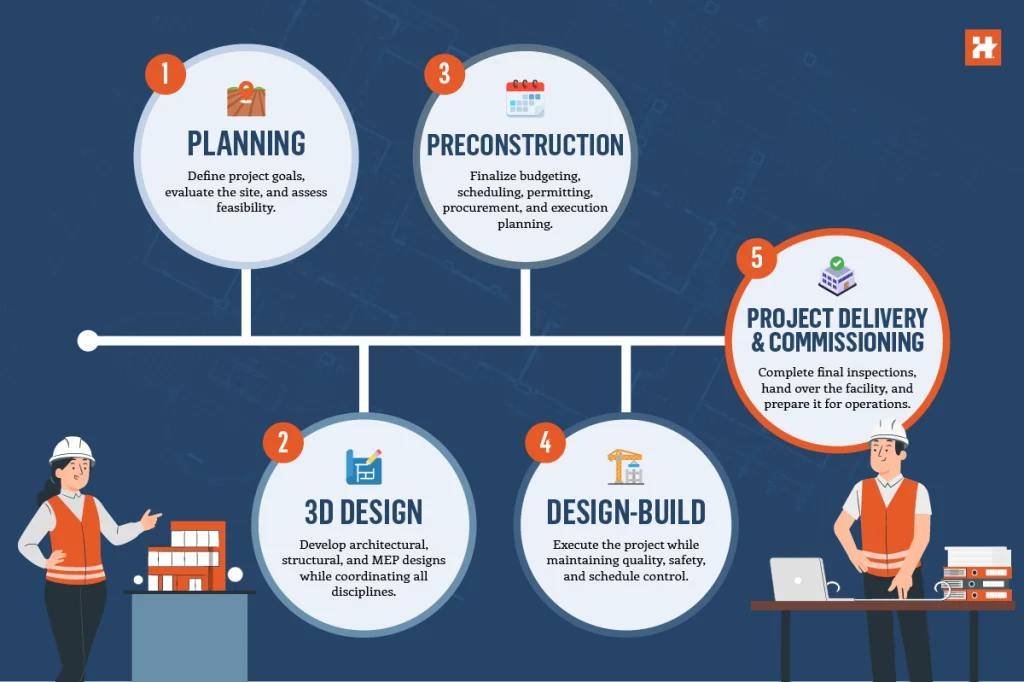
Every manufacturing facility moves through the same basic phases, regardless of size, sector, or geography. What varies is how long each phase takes, and that’s determined by complexity, regulation, and how well the project is managed from the start. Below are the general manufacturing facility construction timeline ranges for each phase, many of which could overlap in real-world scenarios.
Pre-Construction Planning and Site Selection
Typical duration: 2–4 months
Pre-construction covers feasibility analysis, site evaluation, early budgeting, and preliminary design. It also includes choosing a delivery method and lining up the right partners. None of that is glamorous, but it’s where the construction timeline is either set up to succeed or set up to slip.
Scope changes during construction are the most expensive kind of delay there is. And almost all of them trace back to work that should have been done in this phase but wasn’t. Feasibility shortcuts have a way of showing up later as budget overruns and missed milestones.
Permitting and Regulatory Approvals
Typical duration: 2–4 months
Most new manufacturing plants require building permits, zoning approvals, and environmental impact assessments. The specific requirements depend on the jurisdiction, the type of facility, and what you’ll be producing. Certain industries, like food processing, pharmaceuticals, or anything involving hazardous materials, carry additional layers of review.
A contractor who has been through the local permitting process before can make a real difference here. They know which agencies to talk to, what documentation to submit, and how to avoid the back-and-forth that bogs most first-time applicants down. In contrast, a team that’s unfamiliar with the local process can easily add months.
Foundation, Structure, and Utility Installation
Typical duration: 5–9 months
Once permits are secured and the site is prepped, physical construction starts. Foundation work, structural framing, and building size drive the front half of this phase. A 50,000-square-foot assembly facility moves through foundation and steel much faster than a 300,000-square-foot plant with reinforced floors and heavy crane loads. The difference isn’t just scale. It’s complexity.
Meanwhile, utility installation should be running alongside structural work on any well-managed project timeline. Electrical, HVAC, process controls, plumbing, waste management. All of these trades need to be coordinated with the structural schedule so they don’t hold each other up.
Certain facility types add further complexity. Food and beverage construction companies deal with sanitary design, temperature-control systems, and clean-in-place infrastructure. Similarly, a warehouse construction company building cold storage or temperature-controlled distribution space faces utility demands that a standard manufacturing shell doesn’t.
Equipment Installation and Commissioning
Typical duration: 2–6 months
Equipment installation doesn’t always wait until the entire facility is complete. Through beneficial occupancy, designated areas of the building can be turned over early once they are enclosed and weather-tight, allowing production equipment installation to begin while construction continues elsewhere. Although permanent utilities such as power, water, compressed air, drainage, and fire protection may not yet be fully operational, this approach can save months on the overall schedule.
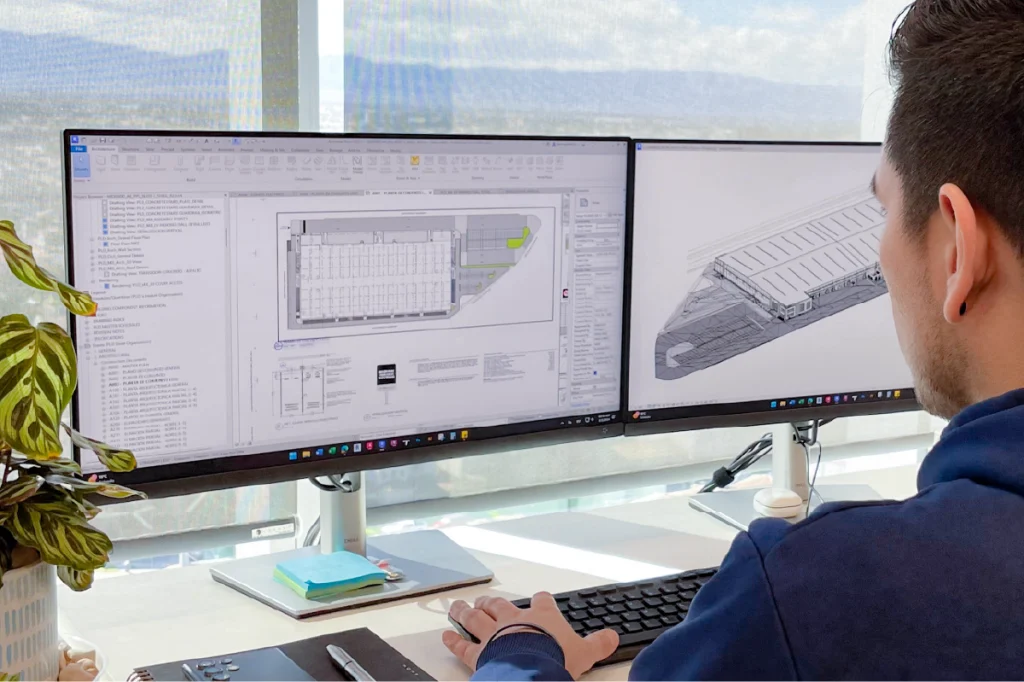
With a Design-Build approach, coordination starts even earlier. During design, equipment suppliers can work alongside the project team using the federated 3D BIM model to integrate production lines and utility requirements before construction is complete, helping prevent installation conflicts later.
For heavy machinery or automated production lines, procurement often carries the longest lead times—sometimes three to twelve months. Ordering equipment during pre-construction ensures it arrives when the building is ready. After installation, commissioning and testing verify that all systems perform according to design specifications before production begins.
What Affects Manufacturing Facility Construction Timelines
No two manufacturing projects follow exactly the same schedule. But the same factors show up again and again on projects that finish late. Understanding them early gives you a much better shot at avoiding them.
- Facility size and complexity. A light-assembly facility and a heavy-industrial plant are completely different projects. Complex builds require more coordination between trades, longer procurement cycles, and more rigorous testing before handover. All of that adds time.
- Permitting. The permitting process varies by country, state, and municipality. Contractors who know and have experience with the local regulations and have established relationships with the permitting authorities move through this phase faster. Contractors who don’t will figure it out on your schedule and your budget.
- Supply chain and lead times. Equipment and material lead times depend on global market conditions. Procurement decisions made early, during pre-construction, reduce the risk of delays once construction starts. Decisions made late create bottlenecks that ripple across the rest of the schedule.
- Workforce. Skilled labor shortages affect both construction time and equipment installation time. Labor availability varies significantly by region, so where you build matters just as much as what you build.
- Delivery method. How you organize a project matters as much as what you’re constructing. Traditional design-bid-build runs every phase sequentially. Design/build overlaps them. The difference can be months.
How Design/Build Compresses Manufacturing Construction Timelines
In a traditional delivery model, the design team finishes their work, then the owner puts it out to bid, then a contractor is selected, and then construction begins. Each handoff adds weeks. Sometimes months. The process is slow by structure, not by accident.
Design/build works differently. One team handles both design and construction from the start, which means site work can begin while detailed engineering is still being finalized. Foundation design reflects actual equipment loads rather than placeholder assumptions. And procurement starts during design instead of after it. These overlaps are where real time comes off the schedule.
At Hermosillo, we pair design/build with Lean Construction and BIM (Building Information Modeling) to push that compression further. Lean tools like the Last Planner System help us identify constraints before they become delays. BIM gives every team a shared digital model, which means coordination problems get caught on screen instead of on the jobsite.
The result is tighter manufacturing plant construction timelines and fewer surprises along the way.
Building a Manufacturing Facility in Mexico: Timeline Considerations
For companies planning to build in Mexico, the construction phases look the same as anywhere else. But a few factors specific to Mexico affect how fast each one moves.
- Permitting. Mexico’s permitting structure can include federal and state environmental authorizations, municipal land-use approvals, construction licenses, fire marshal requirements, and operating or occupancy-related approvals. Exact requirements depend on the municipality, project type, site conditions, and whether the facility is located inside an established industrial park. Parks that already hold environmental studies, industrial zoning approval, and infrastructure permits can cut weeks or months off the approval process.
- Infrastructure readiness. A site with existing road access, power, water, and drainage moves faster than a greenfield location that needs new infrastructure built from scratch. Mexico’s major industrial corridors in Monterrey, Bajío, and the border region have well-developed parks where that infrastructure is already in place.
- Local expertise. A general contractor with deep experience in Mexico knows the regulatory landscape, has relationships with the local authorities, and has an established supply chain. That kind of knowledge directly affects how fast a project moves. Hermosillo has operated across Mexico for 60+ years, completing 1,200+ projects. We know the territory.
Build with Hermosillo
Getting manufacturing facility construction timelines right starts with the right partner. For more than 60 years, Hermosillo has delivered manufacturing facilities across Mexico for American, European, and Asian companies. Our teams understand international standards, work with global specifications, and produce bilingual documentation that keeps communication clear and efficient throughout every phase of the project. We know what drives the schedule, what creates delays, and how to compress timelines without cutting corners.
Planning a new facility? Start a conversation with our team.