We look for what can be better on every project we build. That belief is why Value Engineering (VE) is so fundamental to our work — it’s a method for guaranteeing the best version of a project to the client and the people who will use it.
In this post, we’re defining the concept in everyday terms, 160 characters to be exact, then covering the essential aspects of VE and using real-life examples to show what it can bring to your projects.
What Is Value Engineering? The 160-Character Definition
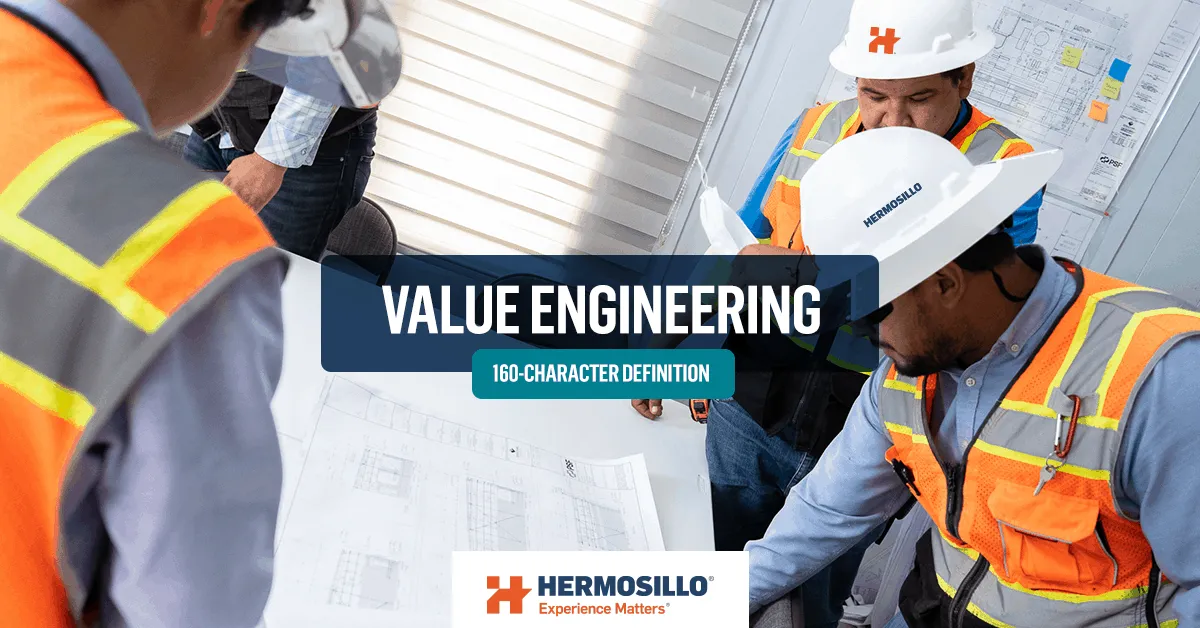
In a nutshell, Value Engineering is a methodology for identifying opportunities to increase a project’s value by maximizing functionality and performance at an optimal cost.
That single notion summarizes the entire method, driving all of the topics and concepts we’re discussing today.
Breaking down the concept of Value Engineering
Simply put, VE is a systematic way of improving a project. Two ideas differentiate VE from any other problem-solving method: methodology and value. To better understand the concept, we will break it down into these two ideas.
History and Evolution of Value Engineering
Value Engineering originated during World War II and was developed by General Electric to respond to the scarcity of materials and resources. Lawrence Miles, an engineer at GE, designed this approach as a systematic way to analyze projects to improve functionality without increasing costs. Since then, VE has evolved and expanded into various sectors, such as construction, manufacturing, and engineering, gaining worldwide relevance. Today, VE is a key tool in optimizing complex projects, enabling multidisciplinary teams to identify and maximize improvement opportunities to offer the best balance between cost and performance.
How is Value Engineering a methodology?
Value engineering is a systematic approach organized around a six-phase sequence called the Job Plan. Following a Job Plan allows the interdisciplinary team to produce consistent and better results in any discipline or trade of a project. Whether the challenge is substituting a material, a piece of equipment, an entire system, or limiting environmental impact, applying the VE method helps identify unnecessary costs and offers a precise solution tailored to each situation.
The Value Engineering Process: Six Phases
- Information phase: The team seeks relevant information about the project, including owners’ objectives (basis of design), key criteria, and definition of value.
- Function analysis: The goal is to identify and understand the project’s needs, product, or service (what does it do, what must it do).
- Creative phase: This is the brainstorming phase. Here, the interdisciplinary team studies the information gathered in Phase 1 and defines VE ideas that can bring tangible benefits to the project, based on the functions identified in Phase 2.
- Evaluation phase: The team evaluates each idea produced during the brainstorming session; some are kept and others discarded.
- Development phase: The team develops the selected VE ideas into workable, technically feasible proposals, each accompanied by a list of pros, cons, and cost comparisons.
- Presentation phase: The team delivers a written report of their findings and an oral presentation to the client, users, and designers. In this final stage, the client decides which proposals to incorporate into the project.
You can use this systematic process in any phase of the project’s life cycle, whether pre-construction, design, or construction. However, VE proposals done during the pre-construction phase are the most cost-effective, as they allow, for instance, early consideration of alternative materials, which can significantly impact cost and performance.
How does Value Engineering provide Value?
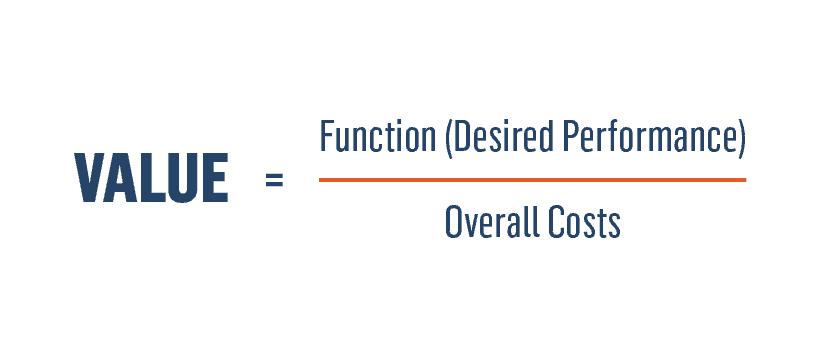
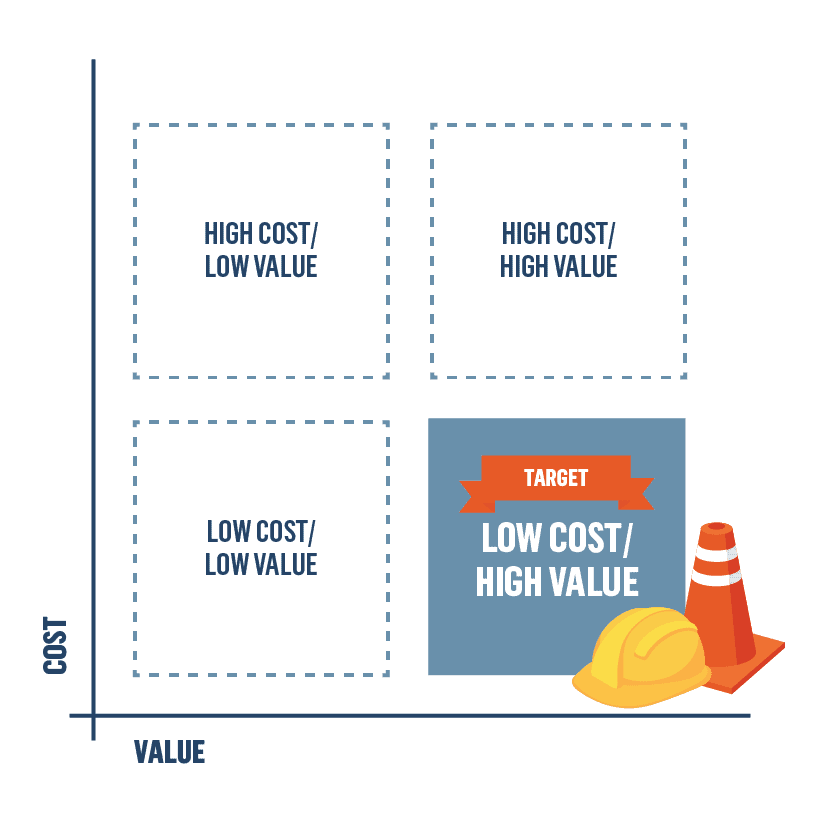
As stated in the 160-character definition, Value Engineering aims to increase the project’s value by detecting opportunities for improvement. Value depends on functionality first and cost second. VE should not be mistaken for a technique to stay within budget or solely to reduce costs. The goal is to maximize function and performance while finding cost-effective solutions. It can be summarized in the succeeding formula:
Product value = function / cost
The formula compares function to cost, never cost to budget. Raise what a component does or lower what it costs, and product value goes up.
To determine the function (see phase 2 of the methodology), you need to ask questions like the following:
- How long will those materials or equipment last? What is their performance? Can it be improved?
- What type of maintenance will they need in the future?
- Will they work more efficiently and cost less to operate?
- The best place to start is to ask yourself: what is/are the most important part(s) of the project and what performance do you want the project to achieve?
- In the end, functionality is determined by the owner’s and user’s goals.
Value Engineering Examples
The following example shows the VE process in the pre-construction phase, from initial review through a delivered cost strategy.
- Step 1. The interdisciplinary team reviewed the project’s information, RFP, and conceptual blueprints to build an accurate cost strategy for the client.
- Step 2. While developing the proposal, the team and the electrical expert identified that relocating certain transformers would reduce the cost of low-voltage feeders, given the distribution layout the client required.
- Step 3. The team evaluated and developed a solution that didn’t compromise the facility’s quality or operations.
- Step 4. The team presented this solution as an alternative and explained the advantages to the client.
- Step 5. After the meeting, the client validated the solution with its technical team and accepted the proposal. This VE solution was cost-effective and improved the facility’s functionality.
This is the same process we run on manufacturing facility construction as well as every other building type we deliver. You can also check out this case study of a bridge construction project in which VE works saved the builder company approximately $43,000,000 and 12 months in total. This saving provided the builder company with a 6% financial savings and a 17% worktime reduction.
Value Engineering vs. Value Analysis
Value engineering and value analysis ask the same question at different moments. Value engineering asks it while the project is still on paper. Value analysis asks it about something already built or already in production.
The timing matters more in construction than in most industries. A wall on a drawing costs nothing to move. A wall that exists costs a demolition crew.
Both look for alternative solutions that deliver the same function at a lower cost. Value engineering finds them before the concrete is poured. Value analysis finds them afterward, and what it learns goes into the next building.
You will hear the two terms used interchangeably across the construction industry. If your project has not broken ground yet, the work you want is value engineering.
Value Engineering and Sustainability
Value Engineering focuses on reducing costs and improving long-term performance and efficiency, making it an essential tool for developing sustainable projects. By applying VE, teams can identify solutions that reduce energy consumption, optimize the use of recyclable materials, and minimize the project’s environmental impact. As sustainability becomes a requirement rather than a loose goal, VE helps balance economic and environmental needs. Implementing VE during the pre-construction phase can make a significant difference by ensuring a more efficient and sustainable project.
In practice, this may include evaluating design options that improve the building’s energy efficiency or integrating renewable energy sources that reduce long-term maintenance costs. Value engineering promotes sustainable and cost-effective design, ensuring the proposed solutions contribute to a lower environmental impact and better project performance.
Selection Criteria for Critical Functions
n the functional analysis phase of value engineering, it is essential to identify the functions that have the most significant impact on the construction project. This includes examining both the project requirements and client expectations to ensure that the selected functions contribute to project progress, generate real savings, and optimize functionality.
During this phase, the team benchmarks essential functions and considers design alternatives or substitutes that maintain quality while reducing operating costs. Selecting the right functions ensures a systematic approach that maximizes profitability and extends the project’s useful life. In this process, the project team explores options through brainstorming, identifies areas for improvement, and finds opportunities to implement more efficient solutions.
Interdisciplinary Participation
The value engineering methodology is based on collaboration between disciplines, ensuring that a comprehensive approach supports each decision.
A value engineering team, including engineers, architects, designers, and cost specialists, ensures that all areas of the construction project are considered. This participation ensures that technical requirements, production costs, operating costs, and maintenance over the project’s life are all addressed.
By working as a team, specialists can analyze alternatives that optimize the project’s functionality while minimizing costs and improving delivery times. This team approach fosters a constant exchange of ideas and allows for a better understanding of the concept, producing more efficient solutions. Decisions based on multiple perspectives ensure that the improvements identified are feasible and beneficial in terms of both cost and risk.
Wrapping Up
Value Engineering is about developing ideas that generate value while systematically optimizing performance and costs. Remember, what sets it apart is that its central goal is enhancing the project’s functionality.
This practice is fundamental to any contractor who strives for continuous improvement. It’s a way of ensuring you are efficient in every step of the project’s lifecycle. As a result, contractors, clients, and users can be sure that the facility built is the best version possible.
For this reason, the VE process is part of our DNA. We are committed to delivering the highest-quality projects to our clients and partners. VE is an essential component of a principle we call Forward Thinking — our commitment to delivering every promise on budget, time, and quality.
We run this process on the buildings we put up across Mexico, including distribution centers and food and beverage plants. The earlier you bring VE into a project, the more it can save. If you’re planning a facility in Mexico, build with Hermosillo.